

Surgery
Preparing for Your Skin Cancer Surgery
Welcome to our skin surgery practice in Newport Beach. We’re here to guide you every step of the way – with real and informed expectations, compassion, and skilled care.
If you’re preparing for Mohs micrographic surgery, we want you to feel informed and comfortable about what to expect. Below, you’ll find information about the procedure, why training matters, and how to best prepare for your day with us.
What Is Mohs Micrographic Surgery?
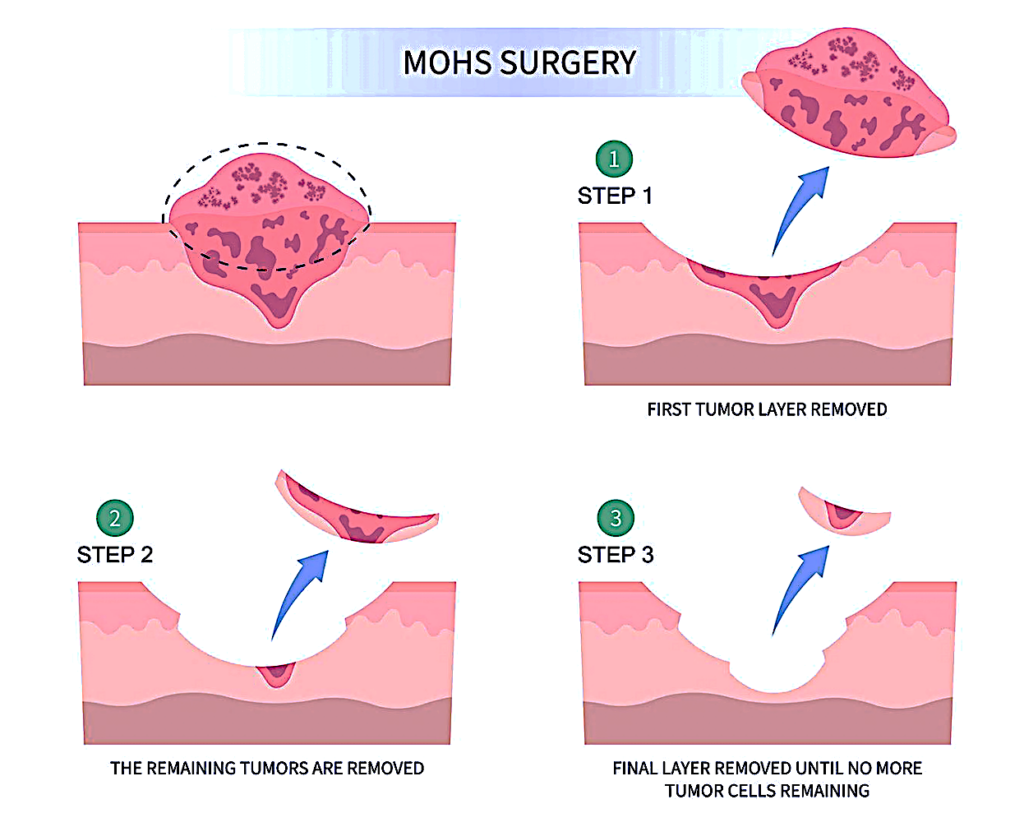
Mohs surgery is a precise and highly effective treatment for skin cancer. It was developed by Dr. Frederic Mohs and is now considered the gold standard for removing certain skin cancers, particularly on the face and other delicate areas.
Unlike traditional surgery, which involves estimating how much tissue to remove, Mohs surgery uses real-time microscopic examination to carefully trace and remove the cancer—layer by layer—while preserving as much healthy tissue as possible.
Here’s what makes it special:
- Minimal removal of healthy skin
- Highest cure rates (up to 98%), even for cancers that have recurred
- Immediate evaluation and mapping of the tissue, reducing the chance of missed cancer cells
You can learn more by watching videos from Dr. Rotunda [insert link].
What to Expect on the Day of Your Surgery
Mohs surgery is a process that unfolds throughout the day. After removing each thin layer of skin, we examine it under the microscope. If any cancer remains, we continue the process—ensuring it’s fully removed before moving on to reconstruction.
Because we can’t predict exactly how many layers will be needed, please plan to spend most of the day with us. We’ll do everything we can to keep you comfortable – feel free to bring snacks (though we have MANY!!), reading material, or a laptop (we have Wi-Fi). We’ll also provide lunch/brunch if you’re here around or over the noon hour.
Once the cancer is removed, we’ll talk with you about the best way to close the wound. Sometimes, this means allowing it to heal naturally; other times, we may use stitches, flaps, or grafts, depending on what gives you the best result. At times also, it is best that we close the wound on another day. Each of these options are discussed in detail and are personalized to fit what’s best for you.
Why Choose a Fellowship-Trained Mohs Surgeon?
Not all Mohs surgeons have the same level of training. Dr. Rotunda completed fellowships approved by the American College of Mohs Surgery (ACMS) – the most rigorous and comprehensive training program in the field.
What does this mean for you?
- They’ve each performed more than 1,500 cases during training alone
- They’ve handled a wide range of complex cancers and reconstructions
- They are skilled in both cancer removal and advanced surgical repair
You can feel confident that you’re in expert hands—receiving care that combines technical precision with attention to comfort, safety, and aesthetics.
Other Surgical Services
Skin Cancer & Growth Removal
In addition to Mohs surgery, Dr. Rotunda often performs excisions for irregular moles, lipomas (fatty growths), cysts, nail changes, and other skin cancers – including melanoma, the most serious form of skin cancer. Many patients are referred by other physicians who trust our experience and surgical skill.
Reconstructive Surgery
Once the skin cancer has been removed, restoring the appearance and function of the skin is our next priority. Dr. Rotunda has extensive experience in reconstructive techniques—ranging from simple closures to more advanced repairs involving skin flaps and grafts. Whether your surgery is performed here or you’ve been referred after another procedure, we’ll guide you through your options and ensure you receive thoughtful, personalized care.
Preparing for Surgery
To help make your experience as smooth as possible, please follow these instructions:
- Take your regular medications, including blood thinners, unless directed otherwise
- Do not take aspirin, herbal supplements, or anti-inflammatory medications (like Advil or ibuprofen) for 10 days before surgery, unless prescribed
- Avoid smoking for at least one week prior to surgery—it can delay healing and result in less-than-optimal outcomes
- Get a good night’s sleep before your procedure
- Eat breakfast as usual the morning of surgery
- Let us know if you have:
- An artificial joint or heart valve
- A history of rheumatic fever or heart murmur
- Been told to take antibiotics before surgery or dental procedures
- If you’re scheduled for Mohs surgery, please:
- Expect to stay with us for most of the day
- Bring snacks (if you have particular dietary restrictions or needs), reading material, and/or your laptop (Wi-Fi available)
- We’ll provide snacks, or you’re welcome to bring your own
- Arrive 15 minutes early to check in and complete any paperwork/electronic check in