

Kybella
View the Kybella Video or Download an informative presentation about Kybella below:
A Journey of Discovery: From Lab Bench to Patient Care
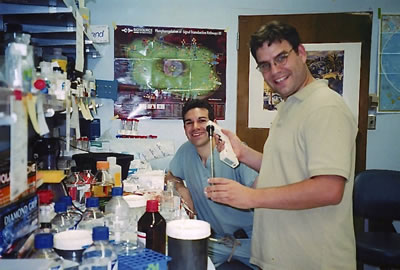
Drs. Rotunda and Kolodney investigate deoxycholic acid
(before it was Kybella™) in 2003.
“This study is going to define your career,” said Dr. Michael S. Kolodney, then Assistant Professor of Dermatology, to a young dermatology resident named Dr. Adam Rotunda. At the time, I had no idea just how true those words would become.
It all started during my first year of dermatology residency at UCLA. Dr. Glynis Ablon invited me to co-author a paper on an intriguing treatment by Dr. Patricia Rittes, who had used a medication to reduce fat in the eyelids—without surgery. Our research suggested similar fat-reducing effects, sparking excitement… and quite a bit of controversy. The mechanism behind this treatment wasn’t fully understood, and questions about safety lingered.
To dig deeper, Dr. Kolodney and I returned to the lab in 2003. There, we identified a key component of the treatment: deoxycholic acid, a natural compound in our bodies that helps digest dietary fat. We discovered that in its purified form, this substance could break down fat cells while leaving other tissue relatively untouched. The implications were powerful—what if fat could be treated non-surgically?
Encouraged by these results, we conducted further studies and found that deoxycholic acid could shrink lipomas, benign but often bothersome fatty tumors. We then published research showing its ability to reduce submental fat (under the chin), a result previously achievable only with liposuction.
These findings led to a collaboration with Kythera Biopharmaceuticals, a start-up that licensed the technology from UCLA/LA Biomed and launched a decade-long journey of clinical trials. After treating more than 2,600 patients across 11 studies, deoxycholic acid was approved by the FDA in 2015 as Kybella™, the first and only non-surgical treatment for moderate to severe submental fullness (commonly called a “double chin”).
Along the way, I’ve had the privilege of publishing multiple peer-reviewed articles, contributing to textbooks, and speaking across the country and abroad about this research. But more than any accolade, I’m proud of the mentorship, teamwork, and persistence that fueled this journey—and humbled by the opportunity to offer this innovation to my patients today.

Kybella™ Q&A with Dr. Rotunda
Why do you offer Kybella™ in your practice?
Over 10 years ago, while I was a dermatology resident at UCLA, I co-discovered that deoxycholic acid – the active ingredient in Kybella™ – could safely reduce fat. What started as a curious finding in the lab eventually became an FDA-approved, non-surgical treatment for under-the-chin fullness.
Although my private practice and teaching have been dedicated to skin cancer treatment and Mohs surgery, I’ve remained involved in Kybella™ research and education throughout its development. It’s an honor to offer this treatment today, knowing its journey from concept to clinic—and the potential it holds to help my patients feel more confident.
Why is Kybella™ getting so much attention?
Before Kybella™, most options for treating submental fullness (the “double chin”) involved surgery – usually liposuction. And while liposuction is effective, not everyone is ready for an invasive procedure.
Kybella™ offers a non-surgical alternative with real, lasting results. It targets stubborn fat under the chin using a naturally occurring compound, with no incisions, no suction, and no downtime from surgery. For many people, this is a game-changer.
How does Kybella™ work?
Kybella™ contains a synthetic version of deoxycholic acid, a molecule your body already produces to help digest fat. When injected beneath the skin, it breaks down fat cells permanently.
Once destroyed, the fat is gradually eliminated through your body’s natural processes—similar to how your body handles fat after a meal. Importantly, the fat does not relocate elsewhere in your body.
Who is an ideal candidate for Kybella™?
Great candidates typically have:
- A moderate amount of fat under the chin
- Firm, elastic skin (not loose or sagging)
- Realistic expectations and a bit of patience
Because Kybella™ works gradually, it’s perfect for people who prefer a natural-looking transformation over time—without the abrupt changes that sometimes come with surgery.
If your skin is quite loose or you’re hoping for very rapid results, we may discuss other options.
Do men get Kybella™ too?
Absolutely. In fact, many men who are hesitant about cosmetic procedures feel comfortable trying Kybella™. A stronger, more defined jawline can make men look healthier, leaner, and more youthful—without it being obvious that “work was done.”
What is a treatment like?
We start by numbing the area to keep you comfortable. The treatment takes about 15–30 minutes, with the actual injections lasting just a few minutes. Most patients feel only mild discomfort, and there’s no need for surgical recovery.
You may experience some swelling, tenderness, or bruising, especially after your first session. Many patients choose to begin treatment toward the end of the week to allow for weekend recovery.
How many sessions will I need?
Most people need 2 to 4 sessions, spaced 4 to 6 weeks apart. Some with more fullness may need a few additional treatments.
What happens to the skin after fat is reduced?
In many cases, the skin remains just as tight—or even a bit firmer—as the area heals. However, if your skin is already loose, we may see some increased wrinkling or neck banding. If that occurs, we can explore other treatments to smooth and tighten the area.
Are the results permanent?
Yes—once the fat cells are gone, they’re gone for good. However, significant weight gain or age-related skin laxity may lead to new fullness over time.
Do I need a consultation before treatment?
Yes, we recommend a quick consultation to ensure you’re a good candidate and to create a personalized treatment plan. If everything looks good and you’re ready, we may be able to start treatment the same day.
How should I prepare for treatment?
To reduce bruising and swelling:
- Avoid aspirin, ibuprofen (Advil®), vitamin E, and fish oil for 1–2 weeks before your appointment (if medically safe to do so).
- Consider reducing alcohol a few days before.
- You may take Arnica montana to support healing.
- Men should shave the treatment area the morning of.
- If cleared by your doctor, take 2 Advil® (400 mg) and 1 Extra Strength Tylenol® (500 mg) with food about an hour before your appointment.
What should I do after treatment?
No special care is required but icing the area for a few hours can help with swelling. Some patients wear a scarf or makeup if they experience visible swelling or bruising.
What are the side effects?
Common effects include:
- Swelling and tenderness (most noticeable after the first treatment)
- Bruising
- Redness or mild numbness, which can last a few weeks
Less common side effects may include:
- Temporary difficulty swallowing (usually due to swelling, not damage)
- Facial asymmetry or smile weakness (rare and short-lived)
- Skin darkening or mild hair loss in men (rare)
Most side effects lessen with each treatment session.
Will I need other treatments to enhance the results?
Possibly. If loose skin, jowls, or neck bands become more noticeable, we can discuss other options—such as fillers, Botox®, or skin-tightening treatments—to help you look your best.
Does Dr. Rotunda offer other cosmetic procedures?
No – my practice is focused exclusively on Mohs surgery for skin cancer, skin excision for melanoma, cysts, lipomas, and Kybella™ treatments. These are the areas where I bring the deepest experience and expertise. If you’re interested in other cosmetic options, I’ll gladly refer you to trusted colleagues.